Roving patrol is one of the most cost-effective security services a Tulsa business can use, and it's the one most often misunderstood.
People hear "roving patrol" and picture a car driving past their property once a night, headlights swinging across the parking lot. That's not what we do, and it's not what real roving patrol looks like.
This is a plain breakdown of what roving patrol actually is in Tulsa, who it works well for, what it costs compared to standing guards, what separates a real patrol service from a drive-by, and how TenSeven Security runs ours.
If you came here because you've got a property that needs more attention than nothing and less than a 24/7 guard, you're reading the right page.
What roving patrol actually is
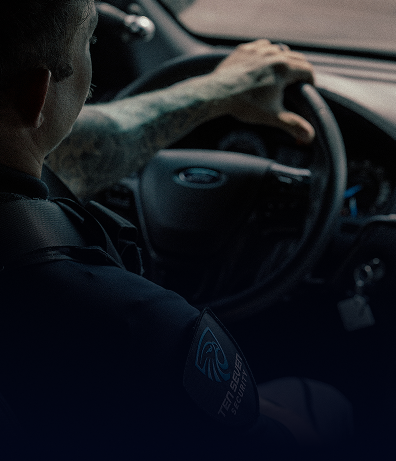
Roving patrol is a mobile, scheduled security service where a uniformed officer in a marked vehicle visits your property on a set rotation, inspects the site, deters and responds to issues, files a report, and moves on to the next location on the route.
It's the practical middle ground between two options that don't fit a lot of Tulsa businesses:
- Nothing (cameras you hope someone reviews after a break-in)
- A full-time guard (one officer at one post, 8 to 24 hours a day, billed hourly)
A roving patrol officer covers multiple properties on a route. Your site might get a visit every 30 minutes, every two hours, or three times a night, depending on what you contracted for. The officer parks, walks the property under written post orders, checks the doors and gates, looks for obvious problems, deters trespassers and loiterers, and documents the visit in a timestamped report.
When done right, it's not a drive-by. It's a foot patrol with a vehicle as transportation between sites.
Who roving patrol is built for in Tulsa
Roving patrol fits properties where a full-time guard is more service than the site really needs, but where having no on-the-ground presence has gotten too risky.
We see these property types most often in Tulsa:
- Apartment communities dealing with after-hours noise, package theft, loitering at pool and laundry areas, parking-lot incidents, and tenant complaints that need a documented response
- Commercial office buildings in downtown Tulsa, midtown, and the Cherry Street and Brookside corridors that don't justify a full-time guard but want overnight and weekend coverage
- Retail centers and strip malls facing break-ins, vandalism, graffiti, organized retail crime, and after-hours dumping
- Construction sites where general site security is needed but the project doesn't justify a 24-hour guard
- Auto dealerships, equipment yards, and outdoor storage lots with high-value assets sitting outside fencing
- Religious facilities and schools between services and outside of school hours
- HOA-managed neighborhoods dealing with car break-ins, package theft, or specific incident patterns
- Industrial parks in west Tulsa, the airport corridor, and Catoosa where lots are vast and there's no on-site presence overnight
If you've called the Tulsa Police non-emergency line twice in the last six months for something that didn't reach the threshold of a real emergency, roving patrol is probably the right tool.
What a real roving patrol visit looks like
A roving patrol visit is not a car slowing down in front of your building. Here's what one of our visits actually includes when an officer arrives at your property:
- Site arrival, vehicle parked in a visible location. Deterrence starts the moment the marked vehicle is seen.
- Foot patrol of the property. The officer walks the perimeter, checks the doors and overhead doors, tests gates, checks the dumpster area, the parking lot, the loading dock, the back of the building, anywhere on your written post order.
- Hazard and irregularity check. Lights out that should be on, water running, doors propped, broken glass, unauthorized vehicles, loitering individuals, anything off the baseline gets noted.
- Engagement when needed. If there's a trespasser or loitering individual, the officer engages, identifies, and asks the person to leave. If they refuse, we coordinate with Tulsa Police.
- Timestamped report submitted on site. Photo of arrival, photo of any irregularity, written notes, GPS-verified timestamp. The report hits your account before the officer leaves the property.
- Move to the next stop on the route.
A single visit takes anywhere from 8 to 20 minutes depending on the property size and post-order detail. A complex retail center with 15 doors and a back loading area might take a full half-hour to clear.
If you're being billed for "roving patrol" and the officer never gets out of the car, you're being billed for theater.
What roving patrol costs compared to a full-time guard
This is the conversation most Tulsa business owners are really asking when they look up "roving patrol."
A full-time uniformed security guard in Tulsa typically runs in the range of $20 to $35 per hour, depending on whether the officer is unarmed or armed and whether the post requires off-duty police staffing. Multiply that by 8, 12, or 24 hours a day, seven days a week, and you're looking at $5,000 to $20,000+ per month for a single post.
Roving patrol is structured differently. Instead of paying for one officer's full shift, you're paying for a share of an officer who covers multiple sites on a route. That brings the per-property cost dramatically lower, usually somewhere between $300 and $1,500 per month in Tulsa, depending on:
- How many visits per night you want
- The size and complexity of the property
- Whether the patrol is overnight only, or also includes weekend and holiday coverage
- How long each visit is contracted to take
- Whether response-to-alarm or after-hours call-out is included
For most Tulsa properties that don't justify a standing guard, roving patrol delivers 70 to 80 percent of the deterrent and documentation value at 10 to 20 percent of the cost.
What separates a real roving patrol from a drive-by
Not every company calling itself a "roving patrol service" runs one. Here's how to tell the difference before you sign a contract.
1. Do they walk the property, or just drive past?
Ask. The answer should be specific. If the answer is "we drive through your parking lot," you're not getting roving patrol. You're getting a vehicle pass.
2. Are the post orders written, or made up on the spot?
A real patrol service runs every site against a written post order that names every door, every gate, every loading area, and every hazard the officer is supposed to check. If the company can't show you their post-order template before they bid, you're hiring a guess.
3. Are reports timestamped and GPS-verified?
Modern patrol software (the industry standard tools include TrackTik, Silvertrac, and similar) timestamps every visit with GPS coordinates, photo verification, and a report log. If you're getting a paper checklist faxed to you the next day, you're operating in 1998.
4. Are the officers trained, licensed, and uniformed?
In Oklahoma, security officers operate under licensing administered through CLEET (Council on Law Enforcement Education and Training). Ask whether your patrol officers are CLEET-licensed. Ask whether they're uniformed. Ask whether they're insured.
5. What happens when something is found?
A good patrol service has documented escalation procedures, when to engage, when to call Tulsa Police, when to call you, when to file a report only. If the answer to "what happens when something goes wrong" is fuzzy, the answer is "nothing."
6. Who's the officer? Is it the same person every week?
Consistency matters. A patrol officer who knows your property knows what's normal, knows your tenants, knows your vehicles, and notices the things a stranger never would. Ask whether your route has assigned officers or whether it's whoever's on shift.
How TenSeven Security runs roving patrol in Tulsa
This is the part where most security companies turn the volume up. We're not going to.
What we do is straightforward:
- Marked vehicles, uniformed officers, written post orders for every property on every route. No drive-bys. No verbal post orders. No mystery officers.
- Most of our officers come from law enforcement backgrounds. That changes how a patrol is run, what an officer notices, how an escalation is handled, and how cleanly a report reads when it ends up in front of an insurance adjuster, a property attorney, or a Tulsa Police investigator.
- GPS-verified, timestamped, photo-supported reports. Submitted on site, before the officer leaves your property. You get every report in your account inbox.
- Consistent officers per route. Your property gets the same officer as much as the schedule allows, so the person walking your site actually knows your site.
- Real chain of command. If a patrol officer encounters something that needs escalation, there's a supervisor on call and a process documented in advance.
- Real response to alarms and after-hours calls when contracted for. Roving patrol isn't a substitute for a 911 response, but for the situations that fall short of an emergency, a patrol response in 15 to 30 minutes is often what the situation actually needs.
We've been running patrols in Tulsa for years out of our office at 4870 S Lewis Ave. The downtown corridor, the Greenwood and Brady districts, the warehouse rows out east near the airport, midtown apartment communities, retail centers near 71st and Memorial, industrial parks, churches, schools, dealerships, we've covered all of them.
Where TenSeven runs patrols in Tulsa
Our routes cover most of the Tulsa metro:
- Downtown Tulsa, the Brady Arts District, and the Greenwood district
- Midtown Tulsa, Cherry Street, Brookside, and the Pearl District
- South Tulsa from 41st to 91st along Memorial, Yale, and Lewis
- The Tulsa industrial corridor and Catoosa
- Broken Arrow
- Bixby
- Jenks
- Owasso
- Sand Springs
If your property is in the Tulsa metro and you're considering roving patrol, we can almost certainly get you on a route. If you are outside of Tulsa, we provide security services across the entire state and are willing to find the best way to service your needs to ensure your assets are protected and mind alleviated - giving you the ability to focus on what matters.
What to do next
If you're weighing whether roving patrol is the right call for your property, here's how the next step works at TenSeven.
You call or email. Tell us about the property: address, size, what hours you need covered, what specifically has been happening (or what you're trying to prevent). We schedule a walk-through at the property, build a written post order, and put a proposal in front of you with a clear scope and a clear price.
You decide. If it's a fit, we put the property on the route, assign officers, and start patrols. If it's not, we tell you that too.
That's the whole process. No high-pressure sales call. No package deals you didn't ask about. We’ll give you an honest read on whether roving patrol is right for your property, and what it would cost if it is.
FREQUENTLY ASKED QUESTIONS
What is a roving patrol service?
A roving patrol service is a mobile security service where a uniformed officer in a marked vehicle visits a property on a scheduled rotation, conducts a foot patrol of the site under written post orders, deters and responds to issues, and submits a timestamped report. It's the middle ground between camera-only security and a full-time on-site guard.
How much does roving patrol cost in Tulsa?
Roving patrol in Tulsa typically costs between $300 and $1,500 per month per property, depending on the number of visits per night, the property size, the route, and what services are included. For comparison, a full-time uniformed guard at a single Tulsa post usually costs $5,000 to $20,000 or more per month.
Is roving patrol the same as a drive-by?
No. A real roving patrol visit includes the officer parking, walking the property, checking doors and gates, identifying hazards, and submitting a timestamped on-site report. A drive-by is a vehicle passing the property without stopping or inspecting. If a security company's "roving patrol" doesn't include foot patrol at each stop, it's not the same service.
How often will an officer visit my property?
Visit frequency is set by the contract. Common Tulsa patrol contracts include one visit per night, two to three visits per night, or hourly visits during high-risk windows. The right frequency depends on what you're trying to deter and what risks the property faces.
Do roving patrol officers carry firearms?
TenSeven Security offers both unarmed and armed roving patrol depending on the property and the contracted service level. Armed patrol is more common at higher-risk sites such as cash-handling businesses, dealerships, and properties with documented threats.
What areas of Tulsa does TenSeven Security patrol?
TenSeven Security runs roving patrol routes across the Tulsa metro, including downtown Tulsa, midtown, south Tulsa, the industrial corridor, Catoosa, Broken Arrow, Bixby, Jenks, Owasso, and Sand Springs.
Will I get a report after each patrol visit?
Yes. Every TenSeven roving patrol visit produces a timestamped, GPS-verified, photo-supported report submitted on site before the officer leaves the property. Reports are accessible in your client account.
Can roving patrol respond to alarms or after-hours calls?
Yes, when contracted for. Alarm response and after-hours call-out can be added to a roving patrol contract. Patrol response is not a substitute for 911, but for situations that don't reach an emergency threshold, an officer on scene in 15 to 30 minutes is often what's actually needed.
Are TenSeven roving patrol officers licensed in Oklahoma?
Yes. Roving patrol officers are licensed through Oklahoma's CLEET (Council on Law Enforcement Education and Training), uniformed, insured, and operate under written post orders for every property on every route.
How is TenSeven Security different from other Tulsa patrol companies?
Most TenSeven officers come from law enforcement backgrounds. We use written post orders for every property, walk the site at every visit, submit timestamped reports on site, and assign consistent officers to each route so your property is patrolled by someone who actually knows it.